
The list of jobs that used to need a specialist and a fortnight gets shorter every few months, and it is going in a fairly predictable order: stock photography first, then voiceover, then illustration, which has been quietly dying for two years without anybody holding a funeral. Motion graphics went this month.
Prices falling is not the interesting part, because prices fall all the time and we are all thoroughly used to it. What matters is where this one landed once it fell, which is on hardware you can buy outright and stand in a cupboard, and that has not been true of any of the crafts before it.
Fifteen seconds that used to be a four-figure invoice
Somebody asked Claude, the assistant made by Anthropic, for fifteen seconds of video showing off what a good motion designer it is, and it produced one: spinning type, letters pouring like metal, the sort of title sequence that used to mean a fortnight of emails and a serious number at the bottom of a quote.
Anthropic shipped it on the 8th of October as Claude Motion, in beta, on the business plans for now.
There is no film-making machine inside it. Claude writes code, the code animates the words, charts and shapes you handed over, and Anthropic are quite firm about what is absent: no video model, no generated footage, nobody in the frame who does not exist. You download an MP4 at the end, but the thing that made it was a program running.
None of which is new. Below is a basic Three.js example, running on your graphics card in the page you are reading, and it was not made with Claude Motion.
That is the field off the front page of this site, dropped into the middle of an article: a few thousand points of light gathering into a tool, turning on the spot, then scattering and gathering into the next one.
The technique has been sitting there for years and Anthropic have invented none of it. What they have removed is the person who used to be needed to write it.
What you can actually do with that
For thirty years the output of expensive creative software was a file that only that software could open, which is the real mechanism of the Adobe lock-in everybody misremembers as having been about the monthly bill.
What comes out of Claude Motion is text, so you can read it, keep it, hand it to a developer, run it ten thousand times with a different name on each one, and nothing anywhere in that chain needs a licence.
What I am most hopeful about sits further down the line than cheaper titles. Almost every website built since about 2014 looks like the same bowl of porridge, and that is not designers running out of ideas: a card grid was free, while something strange and specific to you cost eleven grand and an argument with whoever held the budget.
Drop the strange version to nothing and the whole calculation changes.
The box in the spare room
Everything I make runs on my own hardware, and none of it cost what you would assume.
The pictures come out of ComfyUI, which is free and open and does nothing more exotic than let you wire a chain of models together and press go. Stills take about thirty seconds each.
When one comes back wrong, a second model edits that exact picture rather than drawing a fresh one. Three minutes, and it is the whole difference between a pipeline and a slot machine.
The narration is a clone of my own voice, made on the same machine. So is the music.
The machine is a small desktop box that cost less than a secondhand Golf. Twenty cores, a lot of memory, and the only operational note I have written about it all year reads: render only on Sparky, playing games.
Three things came off it.
The first is eight minutes on the twelve ways a world containing a machine cleverer than us could turn out, which is the physicist Max Tegmark's list rather than mine. Every picture, the voice reading it and the music underneath were made in that room. The only thing it cost was electricity.
The second is a mock public information film about Britain getting on with artificial intelligence. Five people in one town tell the camera that everything is fine while it extremely is not: a student whose essay nobody read, a pensioner on the phone to a scammer, solar panels on fire, a widow having her tea with her dead husband on a tablet, and a woman at her own funeral.
That is the one where I found out you get to choose a style, which I had not expected.
It was briefed as the League of Gentlemen meeting Wes Anderson. A town that is quietly wrong, shot straight down the middle, terribly calm about what the machines are getting up to. Little Britain's sort of humour, pointed at the technology rather than at the people.
No preset anywhere does that. I described it in a sentence and it held across every frame, which used to be the job of a style guide and somebody senior enough to enforce it.
The third is an early pass at something considerably dafter.
A human zoo is not a phrase anybody invented for a film. We built them: pavilions at the great world's fairs with people shipped in from the colonies to live inside while visitors walked past and looked. The last big one was a Congolese village at the Brussels Expo of 1958, which is inside living memory.
So take one of the twelve futures, the one where the machine keeps us roughly the way we keep animals, and do it as an action thriller trailer. In a world.
Britain ninety years out. Four million people in eleven reserves that are genuinely beautiful. Nobody working, nothing walled, and you can leave any time you fancy, because there is nothing outside to eat or drink or stand on.
Every beat of a summer trailer played dead straight over the top of it: the deep voice, the scientist who spots it first, the councillor addressing his people, the dad who packs the car and races for the edge. He gets there, and the gate is open.
Where the three differ
The first is still pictures given a slow push across the screen, which is the oldest trick in documentary and costs almost nothing to run. My voice, cloned once, reads all twelve.
The other two have moving footage in them. Every shot started life as a still, went to a video model, and came back as a few seconds of film with the people in it walking about and talking. Their voices are invented by the same model that drew their faces.
A year ago you got two or three seconds out of a model and it came back awkward: faces sliding about, somebody gripping a mug with six fingers round it. That is the bit that changed, and it changed quickly.
The gap between making them is smaller than it looks, though, because the generating is about a fifth of the job.
The rest is editing. Working out what the thing is actually about, writing it, cutting it, watching it back and finding the middle sags, moving two shots, writing a better line, cutting it again. None of that has got cheaper and I do not expect it to.
It is also the part that carries over. The composition is done the same way every time, a timeline and a running order decided by a person, and the only thing that differs is the media dropped into the slots.
Keep the edit, swap the media, and the whole lot re-renders overnight for the price of the electricity. That is where motion and a machine in your own house start to matter. The judgement stays expensive. Everything underneath it went free.
Anybody telling you the machine makes the film has not sat through the part where you watch your own film forty times.
What each one actually ran on
| The piece | Pictures | Sound |
|---|---|---|
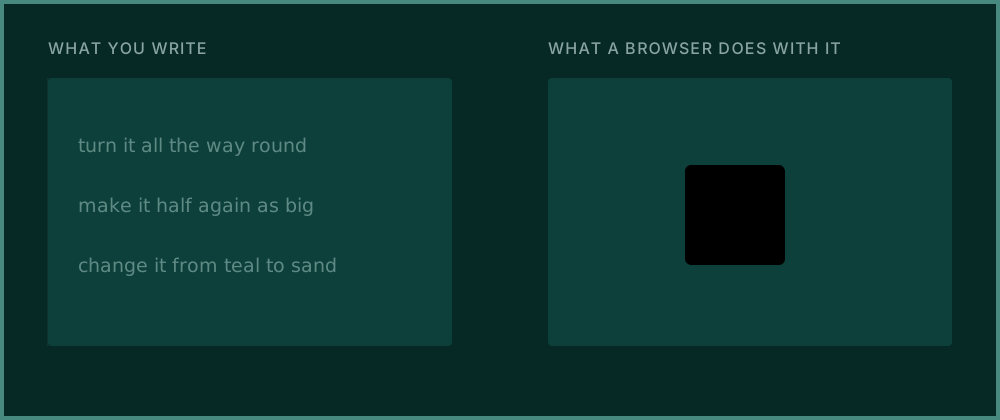
| The square, further up | About forty lines of SVG I typed myself | None |
| The gold shears | Three.js, drawing live in your browser | None |
| Twelve futures | Flat illustrated cards from Qwen Image, assembled by Remotion | My voice, cloned with Qwen3-TTS; music from ACE-Step |
| The public information film | Qwen Image for the cast, LTX-2.3 turning each still into a shot | LTX speaks every line; music from ACE-Step |
| Kept | The same again | LTX on camera; Qwen3-TTS for the trailer voice; bed from ACE-Step |
Two things in there are worth a look. Remotion, which assembled the eight-minute film, is a browser rendering code to frames: the same trick Claude Motion is doing, and free for years.
And everything in the right-hand two columns downloads for nothing and ran on the box.
Video was the last of these to turn up and it has now turned up. Lightricks put the whole of LTX into the open in January, code and weights together, and since March there has been a free desktop application that runs the entire model on the sort of graphics card people buy for playing games.
The newest version makes ten seconds of video out of a single still in under seven. That is their own figure on their partner's hardware and deserves roughly the treatment you give a manufacturer's mpg number. The direction of travel is not in any doubt though.
Stills, voice, music, video and now motion graphics are all sitting on a shelf in my house, for nothing.
Almost none of this came from a company
Here is the part that gets left out, because there is no press release in it and nobody holds shares in the outcome.
Three.js, which drew the shears above, is free. ComfyUI is free. The video models are published with their weights, so you download the actual thing rather than rent a view of it.
And Blender, which does what Maya and Cinema 4D do and is now sitting in the credits of films that cost real money, is free as well.
Blender is the one worth stopping on, because of who pays for it. Around forty-odd firms fund the thing: NVIDIA, Intel, AMD, Microsoft, Netflix, Google, Qualcomm, and, for reasons I would genuinely love to have explained to me, BMW. Adobe is on the list too. The company whose entire business is renting you creative software pays into the free one.
Claude Motion sits on top of all of that. What Anthropic added is the translation from an English sentence into the code, which is new and which is useful, and it is a thin slice on a very deep cake that volunteers baked.
What I actually want back is Flash
It will not be better title sequences. We already had perfectly good title sequences and the only thing that has changed is the invoice.
Anybody under thirty will need this explaining. For about a decade either side of 2000 a lot of the web was built in a thing called Flash, and visiting a website could be an event. A loading bar, and then something: games, daft toys that did one stupid thing beautifully, agency sites where you had no idea what moving the mouse was going to do.
Then Apple refused to put it on the iPhone and the whole lot was switched off for good at the end of 2020. Quite right too. It was a plugin you had to go and install, it drank batteries, it was an open door to anybody writing malware, and neither Google nor a screen reader could read a word inside it.
Nothing ever replaced the fun. Now the page can make the motion itself while you are looking at it, for you, at no cost per view, out of the plain ingredients every browser already understands. The event without the headaches.
Nobody has the faintest idea what to do with that yet and the first attempts will be dreadful, which is fine, because the first thing anybody did with a web page in 1996 was stick a counter at the bottom saying how many people had visited.
Sources
- Claude Motion: Anthropic, 8 October 2026
- The films: Twelve futures for AI on YouTube, after Max Tegmark's list. The public information film and Kept are both unreleased, so they are hosted here
- LTX: Lightricks' LTX-2 release, October 2025; full open weights, January 2026; LTX Desktop runs it locally, March 2026; ten seconds of video in 6.8, August 2026
- Human zoos: the end of them, Royal Museum for Central Africa; the 1958 Brussels village fact-checked, Snopes
- Tools in the table: Qwen Image, LTX, Qwen3-TTS, ACE-Step and Remotion, all free to download
- Flash: Adobe switched it off on 31 December 2020
- Who pays for Blender: Blender Development Fund
- Three.js and ComfyUI