





we design, build, govern
and rescue technology.
Fractional CPTO for boards, founders and CTOs.
Anyone can get a thing built now. Governing it for three years is the bit that pays. It starts with a coffee and a chat.
The gap
Almost nobody rings me confused. They ring me certain and stuck.
The distance between the idea and a thing that exists is made of people, sequencing, architecture and about forty decisions nobody has written down yet.
You have a Ferrari in the garage and you intend to drive it to the shops once a week for a pint of milk. It only ever goes to the shops because nobody in the building has been hired to drive it properly, and that is the gap: the driver, not the car.
Whoever rings is usually the most certain person in the building. A finance director who knows precisely what the business should be able to do by Christmas, or a chairman with a proposition and thirty years of knowing why it works.
The exception is the chairman whose technology has gone off the path, and what makes him nervous is that nobody left in the room can tell him whether that matters. Same job either way, from nothing or from the system you already have and quietly resent.
It usually arrives as one of these four
You know what it should do. There is nobody to build it.
And no reliable way to tell which of the four agencies pitching you is telling the truth, because judging that is itself the skill you have not got.
You have a CTO and they are underwater.
Good person, too much on, and the roadmap is now a list of things that did not happen. They need a hand, not a replacement, and everybody in the market is selling a replacement.
The business has moved and nothing underneath it moved with it.
The platform made sense when it was built. The technology has moved twice since, and your products still sit where the market was three years ago. Three obvious things are now impossible and the estimate arrives with an org chart attached.
The build is late and nobody will say the word.
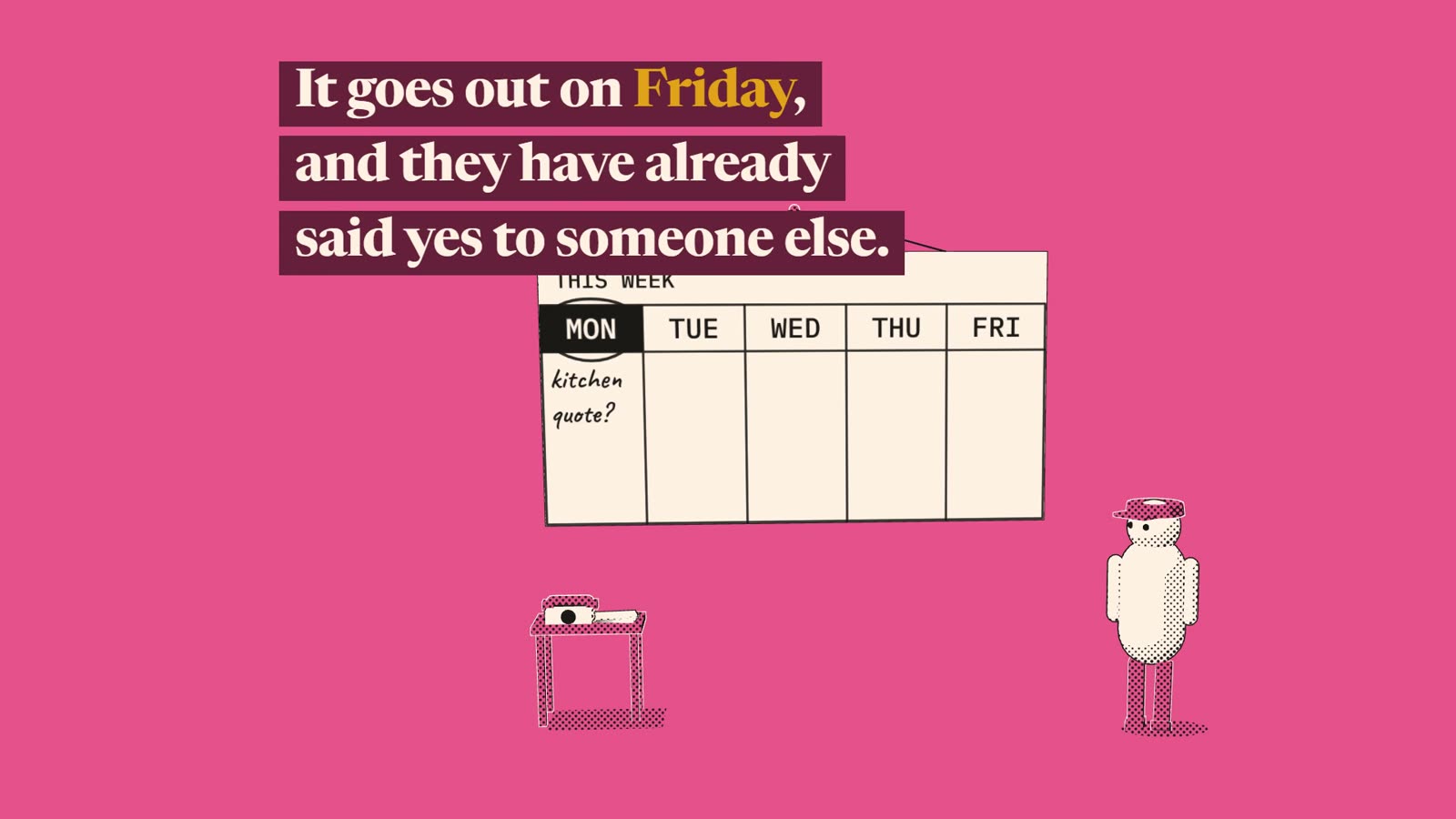
It has been amber for four months, because the first person to say red owns it. Then it goes red in a week and everybody is astonished, which is the surprising bit.
The first job is always the same: put a name and an order on the things standing between you and the thing you already know should exist.
Start with a coffeeWhy subversive
The advantage is rarely where everybody looks.
The name is the method: if the fit sat in the obvious place your competition would have it already, so I look where the answer still sounds like heresy.
I have argued this problem from the brand side, the product side and the engineering side, in that order, which is where the depth comes from. It also means what a customer meets outside and what the business tells itself inside sit in one head.
A Primark suit and a Huntsman one are cut from much the same stuff. Wool, thread, a lining, buttons. The gap is not the cloth. Somebody measured you, and somebody who had cut a thousand coats noticed one shoulder sits lower than the other. AI hands every business the cheap suit, free, same day, no queue. Your competitors have it too. The tailoring is the part still worth paying for, and it is the only part getting more valuable while the tool gets cheaper by the month.
Everyone has the same cheap suit now. The useful hour is the one spent working out where yours needs taking in.
Tell me where yours does not fitThe part nobody staffs
This is how a sound idea gets minuted instead of resourced.
Four things decide it and every one of them is dull, specific and nobody’s job. Who decides, how long the money is safe, what counts as working, and whether the thing is allowed to skip the process built for the business you already have.
You already have the idea, and mostly the people. What you have not got is anybody whose actual job is protecting them from the budget round, the sign-off that takes eleven weeks, and the four people who are each slightly accountable and none of them responsible.
Naming which of those is missing takes a fortnight, and it is usually not the one everybody in the building is arguing about. Find out which one it is.
Our founder: David Ashenden
Twenty-five years building creative campaigns, technology platforms and products. The last three specialising in AI, innovation and adoption in enterprise settings.
Which in practice means helping a CTO get the roadmap moving again, an entrepreneur build a business that did not exist last year, or a chairman steer theirs back onto the path to the top.
Two of those products are our own, one of them haveaspot, built with our own money rather than a client’s.
In their words
“David actually listens, which already puts him ahead of most people in enterprise AI.”
He gets what it really is too, not the conference nonsense, but the reality. A lot of it is admin with better marketing, and he doesn't try to dress it up as something magical.
How it starts
Nobody buys the big thing first.
So it starts with a coffee and a chat, and these four are what I would normally recommend out of one. Take the fortnight and it comes off the first quarter.
The fortnight
Fixed fee. Two weeks.
The first thing you buy. A written position on the decision in front of you, and a straight answer on whether I am any use to you.
The partnership
By the quarter.
The actual business. The technology seat: architecture, hiring, the roadmap and the arguments nobody else in the building will start. I hold it, or I work to whoever already does. Reviewed in writing every quarter, endable at any review, no notice period and no minimum term.
The build
Quoted.
Architecture and working software from the same head. What gets left behind is the infrastructure and the people who can run it, who learned it building it rather than on a course.
The read
Fixed clock. Two to three weeks.
Before an investment, or before a board signs. The deck read against the codebase, the team and the run rate, and where those three disagree.
Most people start at the top of that list, and a fair number stop there with a written answer and no partner. That suits me fine.
Start with a chatBefore you ask
Yes, I want the build work.
The polite fiction in this trade is that the person assessing your options has no interest in what you do next. Ask one of them what happens when they do want the work, and watch the answer arrive in six parts.
So I will say it. If I read your platform and there is a build in it, I want that build. Which is the reason the report tells you what it will cost, how long it takes and what I would not do, because I am the one who has to live inside the answer. A firm that will never have to make it work can afford to be optimistic. I cannot.
And if you would rather somebody else built it, that is a perfectly reasonable answer. Hand them the report and I will brief them properly, because what I am after is the thing still working in three years rather than a signature this month.
The alternatives
You have five options and we are only better than four of them.
Somebody is going to sit in the technology seat, and a permanent CPTO you can afford to keep busy beats us every time. The other four thin out on one question: who is still there in year three.
A permanent CPTO.
Three months to hire, six to be useful, and you are hiring for the job you think you have. Promoting from inside is quicker and costs you your best engineer.
A consultancy.
Sixty pages, and whoever builds it is not who you met at the pitch. A partner’s bonus depends on how many are still in your building in March.
An agency or a dev shop.
They will build precisely what you specify, beautifully. Nobody in that building is paid to tell you the specification is wrong.
Another fractional.
Hundreds of them, and plenty are good. Ask what they have shipped with their own money in it, and whether they will work under your CTO. Watch the room on both.
Nothing.
Perfectly reasonable for another two quarters. Nobody ever decides it though. They run out of the year comparing the other four.
If one of the other four is the right answer for you, you will hear that from me before you hear a price. Costs nothing to find out and it rarely runs to an hour.
Ask me which one you needThe obvious question
There is one name on this and you are wondering what happens if I go under a bus.
The we is the practice. The I is who turns up. And the honest answer to the bus is an arrangement you can check rather than a bench you will never be assigned to.
01
Not the bottleneck
I run a small number of engagements at once, which is why I am not the bottleneck I would be at twelve.
02
Written down as it happens
Every decision gets written down as it is made, so the reasoning survives me instead of living in my head and a slide deck.
03
Named hands
Where a job needs more hands, specialists come in by name, on my paper, under my insurance, and you meet them before they start.
Which is also why I don’t pitch, but will happily sit your supplier due diligence, your insurance checks and your security questionnaire. What I won’t do is write sixty pages of tender for work that gets decided in a conversation.
Two weeks of actually working together shows you all three of those in motion, which is more than any paragraph on a homepage can do. Book a chat.
Fit
I work on a few things at a time. That is the only way any of it is any good.
So here are the weeks when people tend to ring, and what actually turns up when they do.
This is for you if
- A board paper is due and the technology section is the part nobody can write
- You are about to sign a build contract and want it read by somebody not selling one
- A build has slipped twice and somebody has to tell the board whether it is fixable
- Your CTO is asking for headcount and you cannot tell whether that is the answer
- You are buying a company and the technology is the part of the deck nobody has tested
- You have bought advice before and what turned up was charm
What actually turns up
- A written opinion you can hand straight to the board. Six pages, not sixty
- A deck, if a deck is what moves it forward, and none if it is not
- The argument against your decision, where there is one, made once and made properly
- Governance that makes the business quicker, not just easier to audit
And if handing a stranger an hour of your diary feels like a lot, send me the three things keeping you awake and I will write back with what I would do about them. Costs you a paragraph.
The service history
Caring is cheap. The proof is the expensive part.
Twelve teams inside a global enterprise IT firm, all solving the same problem separately. The passes from stated requirement to signed-off architecture fell by 75% on their own tracked count, and work their estimators had scoped at two years shipped in six months.
A design system and shared build tooling did it, which is a dull answer to an expensive problem and usually the right one.
That is a delivery result rather than an AI one, and I would rather say so. Swap design systems for models and the failure is identical. Only the invoices are bigger. The AI work there is three years old and still running, which is the only handover test that means anything, and I cannot publish a word of it.
One I can name: TCC, a multi-tenant click and collect system that took 60,000 views in a single hour without falling over.
“A coach sells you belief. An expert tells you which year of the engine to avoid.”
TCC aside, no client is named here, by agreement. Two people will take your call under NDA: one signed the invoices, the other ran the delivery.
The parts I cannot publish are usually the parts worth hearing, so I will tell you on a call which bits I killed and why.
Ask for the awkward versionMoney
I price the work, not the client.
Expertise is not the expensive option: it is the one that stops you spending four hundred grand teaching a chatbot to do the wrong job beautifully.
A price is usually hidden because the firm is pricing the client rather than the work. Fixed fee, agreed before I start, no meter running and nothing surprising on the invoice. One line on the purchase order, and nobody junior learns the job on your budget.
The cheap suit only looks cheap until you count the two you replace every year and the room you lost the moment you walked into it.
Doing nothing costs money too. It just arrives spread thinly across four quarters, in nobody’s name, which is exactly why it keeps getting approved.
Step 1/4
Which of these is closest to you?
Not sure?There is a shape that fits every stage.Drop me a line.
A calculator will only ever give you a shape, so tell me what you are actually trying to do and I will put a number in writing before anything starts.
Ask for the number
Cross-discipline
Most companies promise one thing outside and quietly build another inside.
That drift is rarely visible from inside either half of it, which is the whole reason this practice exists and why I tend to find it in the first fortnight.
The CXO job, chief experience officer, owns two things: what the customer meets, and what the company tells itself it is doing. Usually that is two people who never meet, which is how the sales deck and the roadmap end up describing different companies.
Engineer, architect, product lead, exec. Four rungs, the hard way round. I have written the code, drawn the system and sat in the meeting where it gets signed off, somebody’s job attached.
Much of the value is in what I stop. I arrive with the standing to kill the zombie project your people are too polite to mention, and no reason to pretend it is nearly working.
Nobody ever puts that on an agenda. It usually takes somebody from outside the building to say it out loud.
Start with that gapUncommon Sense
You can read how I think before you pay to find out.
Essays on judgement, taste and the ordinary chaos that keeps good businesses stuck, written by somebody still on the tools rather than selling a framework.
Some of it is about technology. A good deal of it is about why perfectly sensible people keep making the same decision and calling it strategy.

The Shovel and the Teaspoon
You would not put sugar in your tea with a shovel, nor dig the garden with a teaspoon. Both are tools. This is the whole argument about AI in business, and almost nobody selling it has noticed.

Why Looking Expensive Means Less Now
I was once told, by my great uncle Norman, a man adept at gauging his audience with an uncanny charm, that you could tell how much money someone had by the weight of their coat. Not the brand. The wei

The Story That Won’t Be Rewritten
Attention alone is not enough. Salience makes attention into durability.
If one of them describes something going on in your business, that is a decent opening line. Tell me which one
Next step
Start with a conversation.
Forty-five minutes to work out where you are, where you are trying to get to, and what is in the way.
If I can be useful you will know exactly how, and if I cannot I will say so on the call rather than in a proposal three weeks later.
Confidential. No sales theatre.