Field Notes
Before someone sells you an AI OS

A language model on its own is a very bright temp who turns up every morning with no idea who you are. It doesn't know your customers, your prices or what you told it yesterday, so you brief it again. An AI operating system is the office around the temp: a filing cabinet it can read, someone handing out the jobs, house rules about which drawers it may open, and the habit of writing down what went wrong so tomorrow's temp doesn't repeat it. You'll hear the phrase a great deal this winter, mostly from people hoping to sell you one.
Andrej Karpathy describes the machinery well: the model is the processor and its context window is the memory. A business also needs governance, meaning who sets the rules and who checks the output, and it needs a way for each mistake to become a written rule that every later session reads.
Anthropic has handed MCP, the standard for plugging models into other software, to a new Linux Foundation body, with OpenAI, Google and Microsoft signed up beside it. Rivals tend to agree a standard when they expect to sell what sits on top of it. Microsoft announced that Windows was "evolving into an agentic OS", Nothing raised $200m to build an AI-native one for phones, and two research firms value the market at $3.2bn and $12.85bn.
Gartner reckons four in ten enterprise applications will carry task-specific agents by the end of this year, up from fewer than one in twenty last year. The same firm expects more than 40% of agentic projects to be scrapped by the end of 2027, and thinks only around 130 of the thousands of vendors selling "agentic" anything are the genuine article. Plenty of last year's chatbots have simply been given a new badge, like a Vauxhall with a Cadillac grille.
Uncommon sense (for busy people)
- An AI OS is half software and half house rules; vendors sell the first half.
- Whoever holds the memory owns your know-how.
- Every mistake should end up as a rule the next session reads.
- The first big buyers are paying for a register of what's running.
- Rent the models by all means, but keep the memory at home.
- Draw your AI OS around how your business already runs.
The early users split into three camps, and each wants something different.
Large companies want to know what's loose in the building. Microsoft's Agent 365 keeps one inventory of every agent a firm runs, whoever built it, and gives each one an identity through Entra, much as a new starter gets a pass and a login. ServiceNow sells an AI Control Tower that does a similar job across other people's agents and models. What both are selling is the personnel file, because a board that can't say how many agents it employs can't say who answers when one of them gets something wrong.
Device makers want the layer your context lives in. Whoever holds what you've told your phone, your laptop and your calendar holds the reason you won't switch, and Microsoft and Nothing are both building for that.
Then there are the tinkerers, building their own out of Claude Code, a folder of notes and stubbornness. The internet is now thick with write-ups of people turning an Obsidian vault into a second brain. I'm one of them.
Mine is homegrown, and it turned out to need more office staff than I expected.
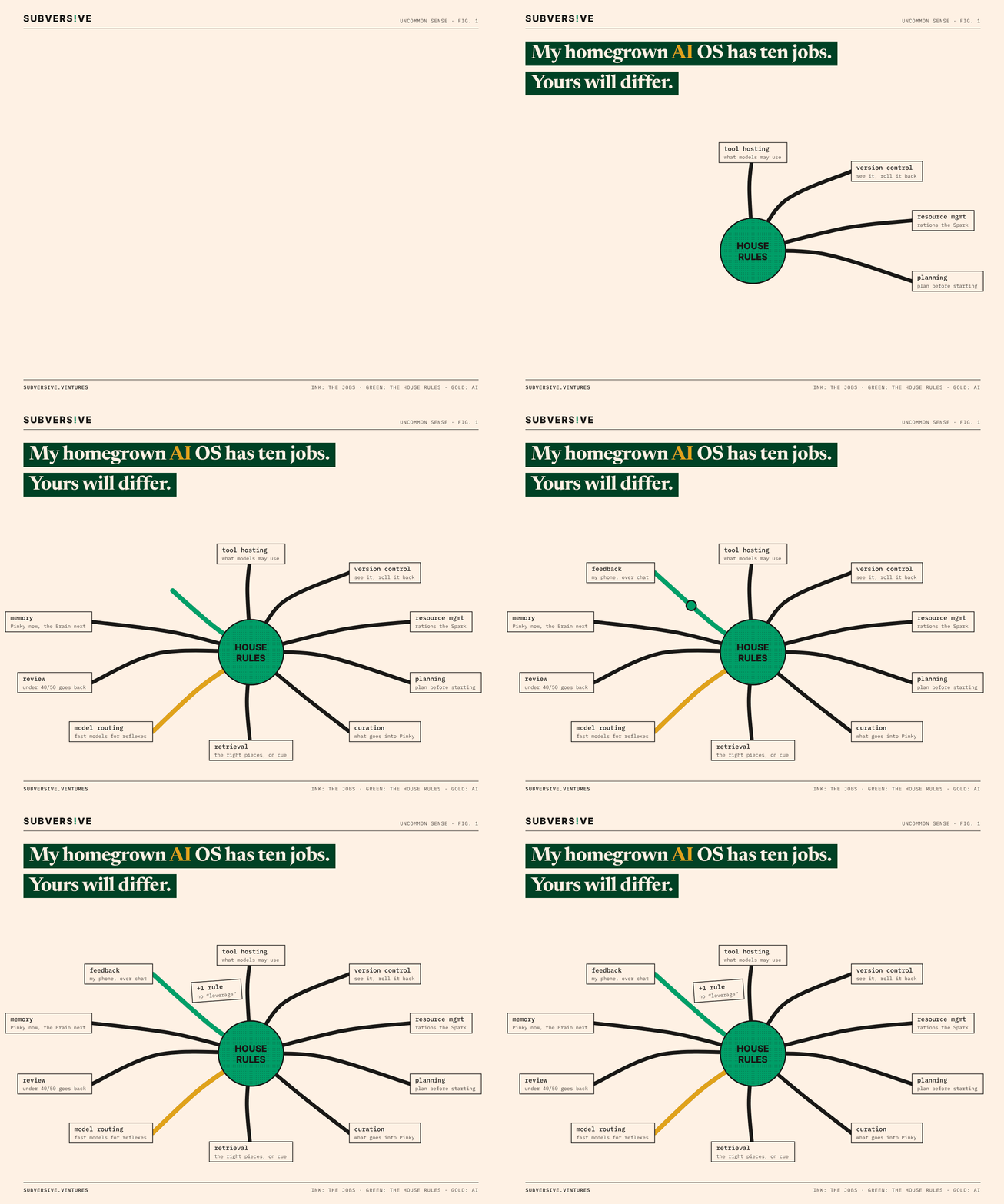
The job I'd keep at any price is the feedback loop. It reports to my phone over Slack or Telegram, and when I reply that something is wrong, the correction goes into a file every session reads. That's how a word I've banned from this column stopped turning up in the drafts.
Yours might well differ, and that's the point. A builders' merchant needs different staff from a law firm, so the jobs, the rules and who checks what should be drawn from how your business already runs. A vendor's feature list describes the vendor's business.
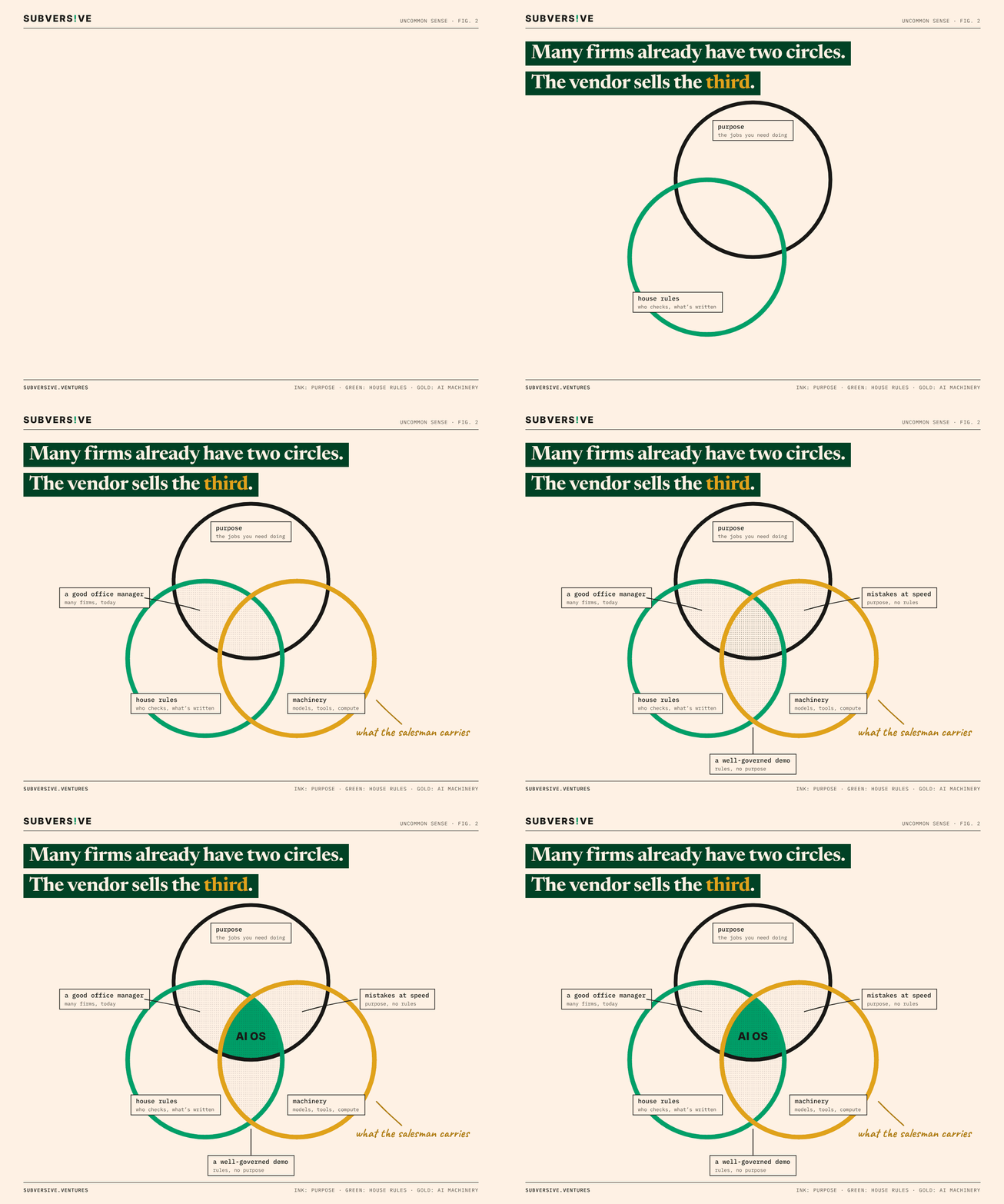
Many of the organisations I work with already have two of the three circles. They know what they need doing and someone sensible keeps the rules, which is to say they have a good office manager. Vendors arrive with the third circle, the machinery, and sell it as though it were all three. Machinery and rules with no purpose gets you a well-governed demo. Machinery and purpose with no rules gets you expensive mistakes at speed.
Where it goes next is guesswork, so take these as marked opinions. Memory will become the thing people fight over, and somebody will need the equivalent of the Current Account Switch Service, so you can carry years of corrections and preferences from one vendor to another without starting again. Agents with identities will get what staff get: permissions, a manager, a log of what they did, and at some point an appraisal. Small fast models will move onto phones and laptops for the reflex jobs, with the big ones called in for the thinking. And the firms that write their corrections down will improve a little every month, which compounds in a way a one-off licence can't.
When the salesman arrives, ask where the memory lives and whether you can take it with you. If the vendor holds the context, you're renting your own know-how back by the month. Ask who answers for the thing when it gets something wrong, and where the log lives. Then ask what happens after a mistake. If the answer is a support ticket, it will make the same mistake in March that it made in January.
A good AI OS should be as unremarkable as the fuse box under the stairs, labelled by someone sensible and opened about twice a year.
If your AI OS is currently a slide deck and a renewal date, I'm easy to find.
Further reading
- Linux Foundation announces the formation of the Agentic AI Foundation
- Windows boss defends 'agentic OS' push as users plead for reliability, The Register
- UK smartphone company Nothing raises $200m funding, Computing
- AI operating system market, Intel Market Research ($3.2bn)
- AI operating system market report, Grand View Research ($12.85bn)
- Gartner: 40% of enterprise apps will feature task-specific AI agents by 2026
- Gartner predicts over 40% of agentic AI projects will be canceled by end of 2027
- Agent registry convergence: Microsoft Entra Agent ID and Agent 365
- ServiceNow launches AI Control Tower
- What is the Model Context Protocol?
- Intro to Large Language Models, Andrej Karpathy